Articles
- Mainter
-
- 3 min reading

A fleet of machines with poor operational reliability that keeps stopping creates stress and unnecessary costs. Unplanned downtime can cost manufacturing companies tens of thousands of kronor per hour in lost production and damaged material. Actively working on your facility’s reliability and implementing a structure that creates predictability and assurance in production delivers stable operations and improves the company’s overall results.
What is operational reliability?
The term operational reliability describes the equipment’s or facility’s ability to perform its intended function for specified periods and under given conditions. Maintenance and reliability work aims to build a production where technology works exactly when it’s needed—machines start on schedule at the beginning of a shift and then deliver the required capacity throughout the day without interruptions.
Benefits
Working on operational reliability means building a production that runs error-free over time. This is achieved through three cornerstones: reliability, maintainability and maintenance readiness. A systematic, proactive approach reduces costly downtime, extends equipment life and contributes to a noticeably more profitable facility.
Three pillars for a stable facility
To understand how this can be achieved we need to look at the three parts that together build the organisation’s capability. Industry standards, such as SS-EN 13306 from Svenska Institutet för Standarder (SIS), divide reliability work into the following main categories:
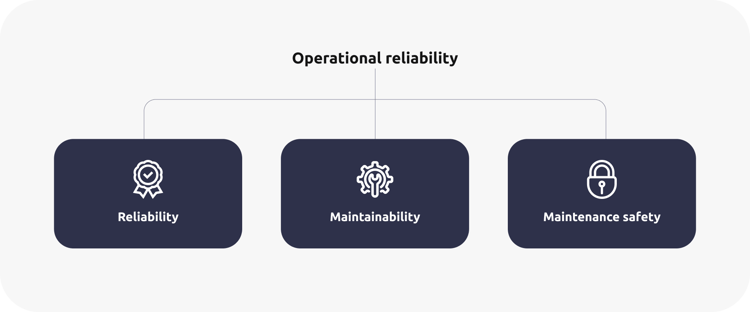
Reliability
Describes the machine’s ability to operate without interruption during a specific time period. Achieving a high level requires the right choice of components from the start, combined with handling equipment according to the manufacturer’s recommendations. A clear example is an industrial pump in a humid environment, where the correct material choice directly minimises wear over time. When your operators run the facility within specified limits, unnecessary overload is avoided and you get a process that runs without costly interruptions.
Maintainability
This measure shows how quickly and easily equipment can be repaired when a failure occurs. The industry commonly divides this into two subcategories:
-
Reparability: How the equipment is technically designed to facilitate service. This includes, for example, machine guards that are easy to remove, clearly marked components and logically placed lubrication points.
- Supportability: How well your facility is adapted to quickly receive and assist maintenance personnel. Physical surroundings matter here, such as adequate lighting, access to the right lifting equipment and free space around the workplace.
Maintenance readiness
Highlights the company’s ability to provide the resources, spare parts and competence required to carry out the work at the right time. This puts the organisation’s logistics, planning and spare-part management to the test. Skilled technicians on site do little good if critical replacement parts are missing from the warehouse. Strong maintenance readiness is built on order and discipline, where digital systems help you always have the right materials and documentation ready when an intervention is needed.
Practical tips for a more profitable production
Successful work requires structure. Here are four concrete steps to increase your facility's reliability and build a more predictable operation:
-
Map the equipment: Collect all information about your machines in a digital machine register to identify the most critical units. When you know which equipment is most critical to the business, it becomes easier to direct resources where they have the greatest impact.
- Start measuring: Collect data on downtime and cause codes to understand where problems occur. Logging every incident builds a history that helps you pinpoint exactly where and why issues arise.
- Create clear routines: Build checklists and work orders that give technicians the right conditions during rounds. Well-written instructions reduce person-dependence and speed up practical work on the shop floor.
- Manage materials: Ensure the right spare parts are in stock before a planned replacement. Avoiding waits for late deliveries cuts unnecessary hours from your downtime.
How to measure your facility's condition
Once you have established routines for operational reliability you create better order in everyday work while you begin collecting valuable data over time. This information forms the basis for evaluating the performance of your fleet and setting measurable KPIs — necessary to know whether your efforts pay off. Here are three common maintenance and reliability metrics that measure equipment condition:
-
MTBF (Mean Time Between Failures): The time between failures, where a higher value means fewer stoppages.
-
MTTR (Mean Time To Repair): The average time to fix a failure and restore operation.
-
TAK value (OEE): A holistic measure of how well equipment is utilized based on availability, performance and quality.
You can calculate a machine's availability in time (as a percentage) with the following mathematical formula:
Availability = MTBF / (MTBF + MTTR)
The link between maintenance and operational reliability
There is a direct connection between maintenance and operational reliability: maintenance is the practical work you perform, and operational reliability is the measurable result. A reactive approach, where technicians respond only after a machine stops, creates an unpredictable work environment and can lead to higher operating costs.
A proactive strategy instead relies on structured preventive maintenance. Regularly working with service, lubrication and inspections prevents wear-related breakdowns before they develop into acute stoppages. By training staff and regularly checking machine condition you regain control of the facility. This systematic approach moves you from unpredictability to stability, laying the foundation for healthier finances, a safer workplace and a more reliable production.
System support for a smoother everyday
A modern maintenance system (CMMS) ties the entire reliability effort together on a digital platform. Technicians can easily report faults directly via their mobile devices and management gets immediate access to statistics to follow KPIs like MTBF and OEE. Letting a digital tool handle administration gives your organisation the right conditions for proactive maintenance. The result is a safer work environment, fewer interruptions and a fleet that delivers stable profitability.
Try for Free
Want to Try Mainter?