Articles
- Mainter
-
- 3 min reading

Investing in a new maintenance system is a long-term and strategic decision. Many organisations choose between EAM and CMMS, and it’s easy to be tempted by broad EAM platforms under the impression that they’re automatically better. Unfortunately, their heavy structure often creates unnecessary hassle for users. Here we outline the differences between the platforms so you can make a wise and profitable investment in your maintenance.
What is an EAM system?
Enterprise Asset Management (EAM) manages an organization's physical assets throughout their lifecycle, such as machinery and vehicles, from design, procurement and installation, to operation, maintenance and final decommissioning or scrapping. An EAM system aims to maximize the value of assets and minimize costs over time, with maintenance being only one part of a larger whole that also includes capital planning and compliance.
Who uses it?
Traditionally, it is mainly used by large, infrastructure-heavy businesses such as energy companies and rail operators. The primary users are management and finance departments, rather than service staff and technicians. The focus is on providing decision-makers with strategic control over depreciation and capital retention, which is very different from the need for operational support on the shop floor.
What is a CMMS system?
CMMS (Computerized Maintenance Management System) is software developed specifically for maintenance within an organization, with a focus on improving operational efficiency. It addresses the specific needs of the department by managing everything from work orders and scheduling to spare parts. The goal is clear: increased reliability, longer equipment life and reduced costs.
Who uses it?
Primarily used by manufacturing and industrial companies, CMMS systems are standard for businesses that prioritize reliability and efficient work processes and want to avoid heavy administration. The primary users are maintenance managers, technicians and operators who need an agile tool for their daily work.
Main differences between EAM and CMMS
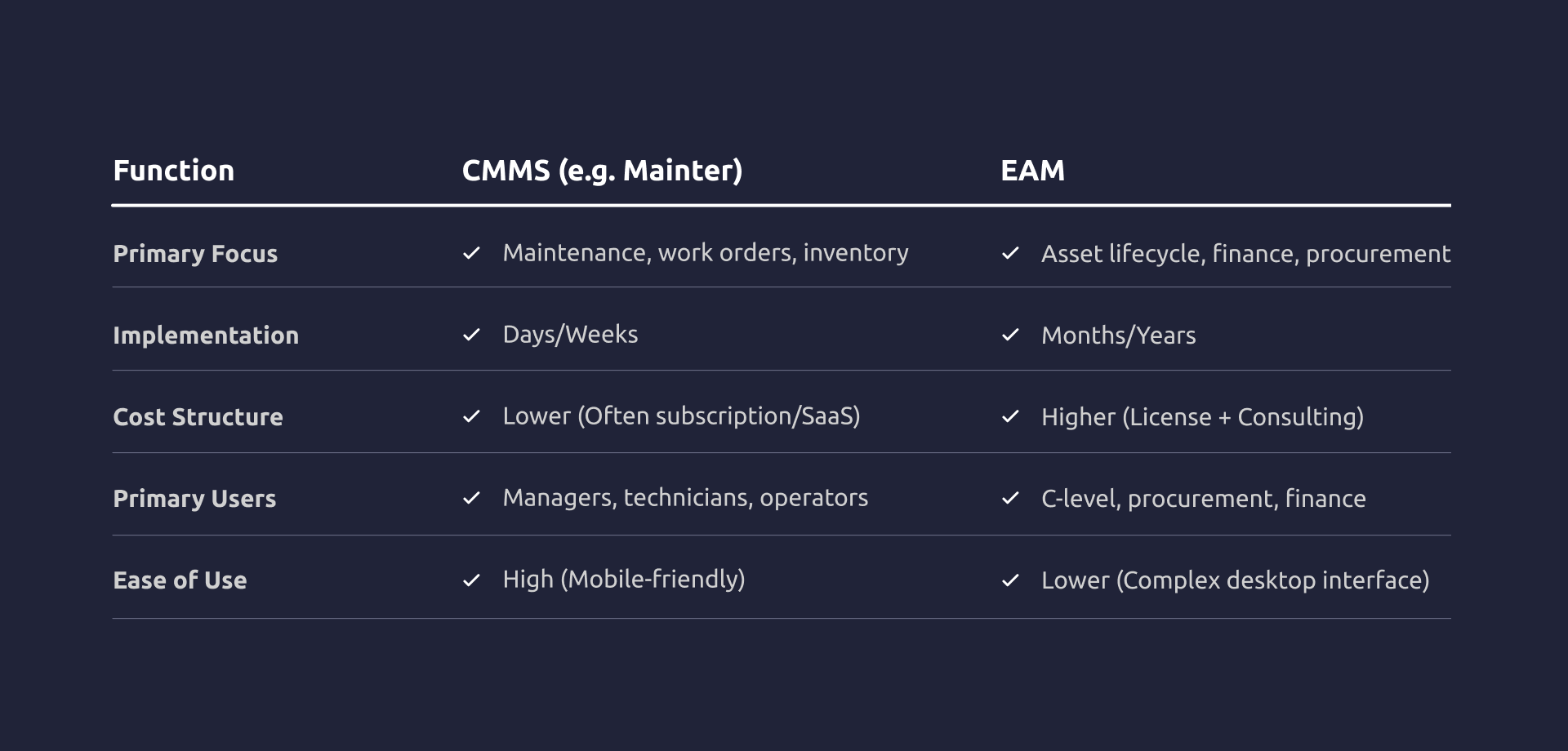 The line between the systems has blurred somewhat in recent years as modern CMMSs have become more powerful, but the basic philosophies still differ.
Cost
EAM requires large investments (Capex) and long, multi-phase implementation projects. A cloud-based CMMS has a much lower threshold, often via subscription (Opex), and can be quickly rolled out to the business.
Intended users
A CMMS is built for those who work on the floor, i.e. technicians and operators. The focus is on high user-friendliness and mobile maintenance. An EAM system is designed for management, finance and purchasing who need strategic data at the macro level.
Integration
An EAM often functions as a centralized, monolithic hub that requires large IT resources to maintain. Modern CMMSs specialize ("Best-of-Breed") in maintenance and use open APIs to seamlessly integrate with business systems or retrieve operational data, without becoming cumbersome.
Functionality
CMMS focuses on operational reliability here and now. The functionality is optimized to cut downtime through smart spare part management, scheduled preventive maintenance and traceable history. EAM instead focuses on the asset lifecycle from an accounting perspective.
In what context does an EAM fit?
A pure EAM is the right choice when the organization's need for financial traceability and lifecycle analysis outweighs the need for a fast-moving tool for daily maintenance. It is suitable for environments where assets are dispersed, extremely expensive, and where compliance requirements demand that every component can be tracked in the accounts, from purchase to scrapping.
When should companies choose a CMMS over an EAM system?
Choose a CMMS when you want to prioritize reliability, ease of use and quick implementation. For the majority of manufacturing industries, this is the most economical choice and the solution that delivers the best results in practice.
Ease of use
-
EAM is often perceived as administratively heavy, leading to poorer data quality.
-
A modern CMMS like Mainter is intuitive, ensuring that staff actually record fault reports and actions.
Faster time-to-value
-
Implementing an EAM system can take years. Mainter is often up and running and adding value to your business in days.
-
You'll see faster results in terms of reduced downtime and better control of the maintenance budget with a CMMS.
Focus on operations
-
CMMS systems like Mainter are designed specifically for maintenance staff, not for administration or finance.
-
Features like scheduling calendars and mobile work orders are tuned to maximize technician efficiency in the field.
Flexibility
-
Heavy EAM systems are often expensive and difficult to change as the business evolves.
-
Since many CMMSs, including Mainter, are cloud-based, it's easy to add new sites and users without expensive consulting hours.
Which system should we choose?
Are you in a quandary? Start by analyzing where your biggest pain points are. Are you a global group that needs to consolidate the balance sheet of thousands of vehicles? Then you may need to look at EAM. If it's more about getting work orders and spare parts in order, and getting engineering and production to work together, then a CMMS is probably the way to go.

Try for Free
Want to Try Mainter?